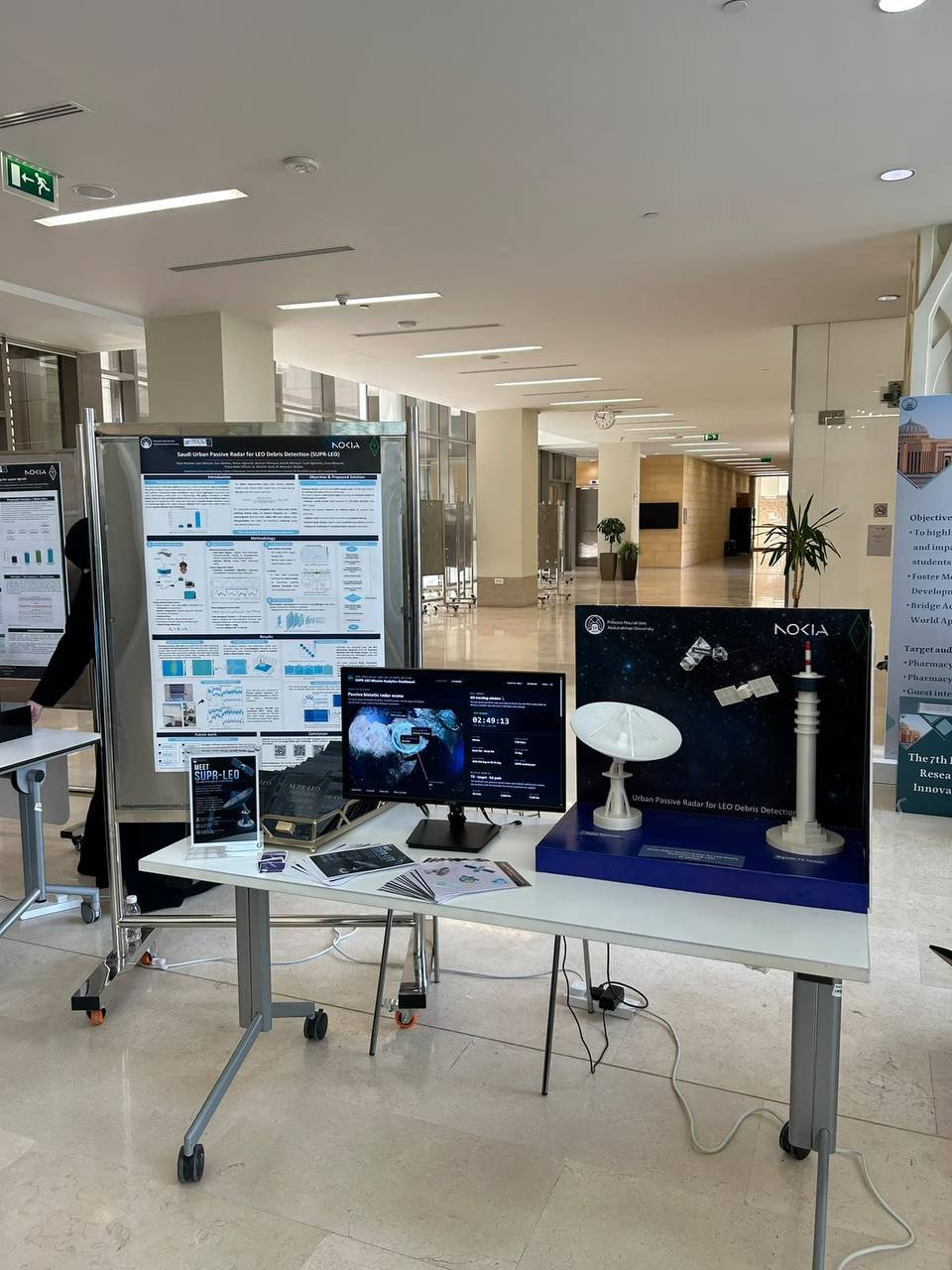
Saudi Urban Passive Radar for LEO Debris Detection (SUPR-LEO)
Develop your technical skills
Discover Electrospace
Share your idea
Develop your project
Explore the world of wireless communications
Be part of the tech community
Project Idea
From an Idea to a Communication Experience
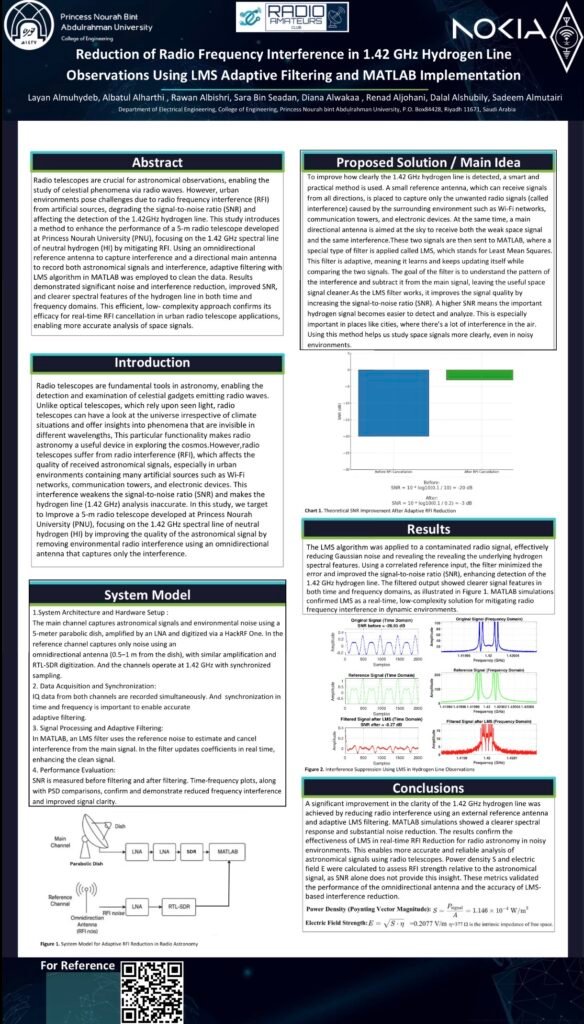
The rapid growth of LEO space debris has become a major
challenge for space sustainability. Thousands of objects travel at
extremely high orbital velocities, increasing the risk of collisions
with satellites. Conventional space surveillance radars require
high-power transmitters and costly infrastructure, which serves as
a disadvantage. This project investigates an Urban Passive Radar
for LEO surveillance (SUPRLEO) that uses existing DVB-T
broadcast towers as illuminators of opportunity while using radio
telescopes as passive bistatic receivers. Instead of transmitting
signals, the system analyzes reflected DVB-T signals from orbital
objects to perform passive detection and classification.
01
The Beginning
How Did the Idea Begin?
With the increasing number of satellites and space debris in LEO (Low Earth Orbit), the risk of collisions has become a growing concern for space sustainability. Conventional systems rely on active radar, which requires high-power transmitters and costly infrastructure. This led to the idea of using existing DVB-T broadcast signals as sources of illumination, without transmitting additional signals.
02
The Idea
What Does the Project Offer?
SUPRLEO proposes an Urban Passive Radar system for monitoring objects in LEO. It uses DVB-T broadcast towers as signal sources and radio telescopes as passive receivers. The system analyzes signals reflected from orbital objects to perform passive detection and classification, providing an alternative approach that makes use of existing infrastructure without requiring high-power transmitters.
03
The Experience
From Concept to Prototype
Project Team
Haya Altamimi
Lyan Alkassim
Sara Aljarbou
Remas Alghamdi
Munirah Althawad
Amirah Alfunaytil
Farah Alghomlas
Arwa Alhassani
Project Supervisor
Prince Bader AlFaisal ,Dr. Walid M. Dyab, Dr. Mourad S. Ibrahim
Project Photo Gallery
A visual tour documenting the manufacturing stages, laboratory testing, and live tracking experiments in the field.
Other Projects in This Edition
Explore the projects and experiments that shape the Electrospace experience.