DE-LEO: Angle-Based Signal Processing for LEO Interference Mitigation in Radio Telescope
Develop your technical skills
Discover Electrospace
Share your idea
Develop your project
Explore the world of wireless communications
Be part of the tech community
Project Idea
From an Idea to a Communication Experience
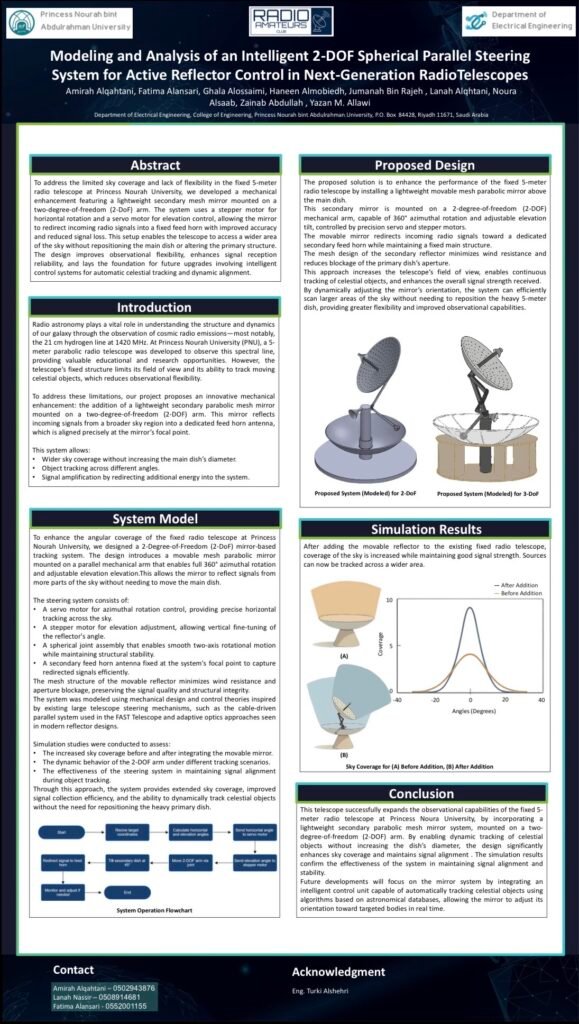
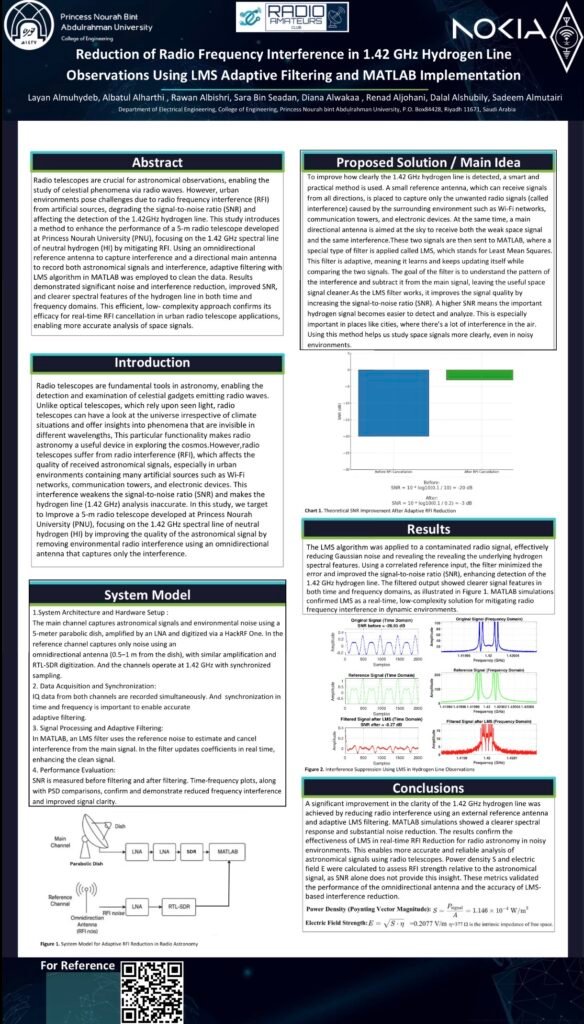
DE-LEO is an angle-based signal processing approach proposed to mitigate LowEarth Orbit (LEO) satellite interference affecting radio telescopes operating near
erence caused by large LEO satellite constellations, especially near the
telthe 1420 MHz hydrogen line. The project addresses increasing radio frequency
inter
fescope boresight where interference becomes strongest. The proposed
solution divides satellite motion into three boresight regions (5°
, 15°
, and 45°)
and applies adaptive filtering intensity based on interference severity at each
e received signal behavior. Optimization analysis identified an
effectiangular region. MATLAB simulations were performed using angle-dependent
antenna gain, thermal noise, white noise, and modeled LEO interference
signals. The results demonstrated significant interference suppression while
preserving t
hve filtering intensity near 0.22, balancing interference reduction and
filtering penalty.
01
The Beginning
How Did the Idea Begin?
The idea started from the increasing RFI caused by LEO satellites, especially near the telescope boresight, where interference is strongest. The project therefore proposed angle-based adaptive filtering, where the filtering intensity changes according to the satellite’s angular position and interference severity.
02
The Idea
What Does the Project Offer?
The project provides an angle-based adaptive filtering method to suppress LEO interference while preserving the received signal. The simulations identified a filtering intensity of approximately 0.22 as an effective balance between interference suppression and filtering penalty.
03
The Experience
From Concept to Prototype
Project Team
Deem Alhantom
Aljawharah Alomar
Joud Almaiman
Aseel Almutairi
Jood Alkhodair
Fatemah Alabdan
Hissah Almodhi
Project Supervisor
Dr.Dhaifallah Almutairi.
Project Photo Gallery
A visual tour documenting the manufacturing stages, laboratory testing, and live tracking experiments in the field.
Other Projects in This Edition
Explore the projects and experiments that shape the Electrospace experience.