Ionospheric Correction and Enhancement of Radio Signals for PNU Radio Telescope
Develop your technical skills
Discover Electrospace
Share your idea
Develop your project
Explore the world of wireless communications
Be part of the tech community
Project Idea
From an Idea to a Communication Experience
Radio astronomy plays an important role in studying celestialobjects and understanding the universe through radio-frequency
tronomy is the hydrogen line at 1420 MHz, which is widely usobservations. One of the most important frequencies in radio
a
sed
to observe neutral hydrogen in the Milky Way galaxy.
Before reaching ground-based radio telescopes, radio signals travel
electromagnetic waves and introduce signal distortion, phase shthrough the ionosphere, a layer of Earth’s atmosphere containing
free electrons and ionized particles. These particles affec
tift,
delay, and scintillation noise, reducing signal quality and observation
accuracy.
This project investigates the influence of ionospheric disturbances
on radio signals using real observational data from the PNU Radio
Telescope. MATLAB-based signal processing techniques, including
RFI f
itering and TEC-based ionospheric correction, were applied to
analyze and improve the received signals.
01
The Beginning
How Did the Idea Begin?
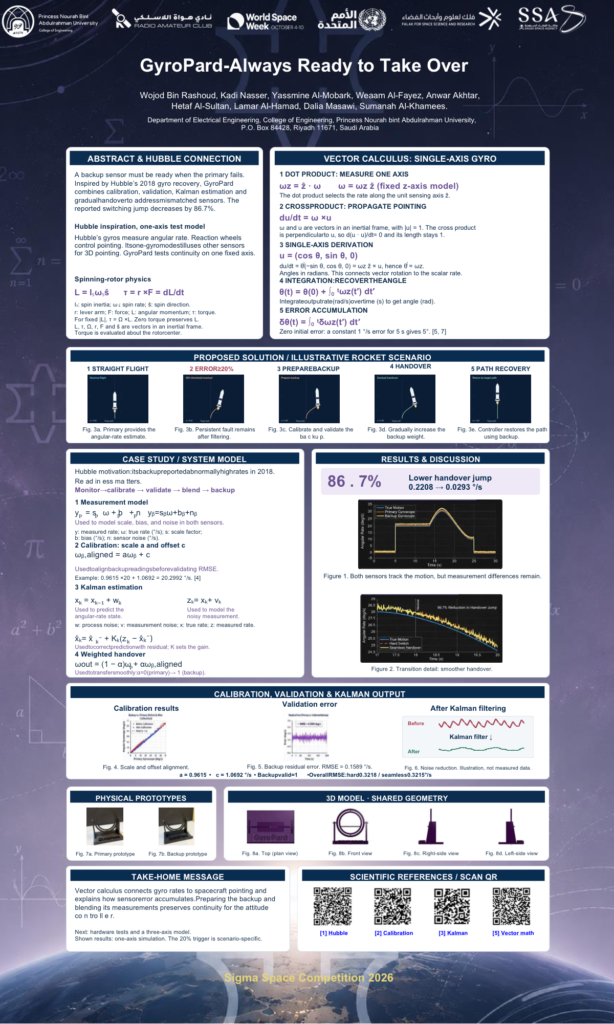
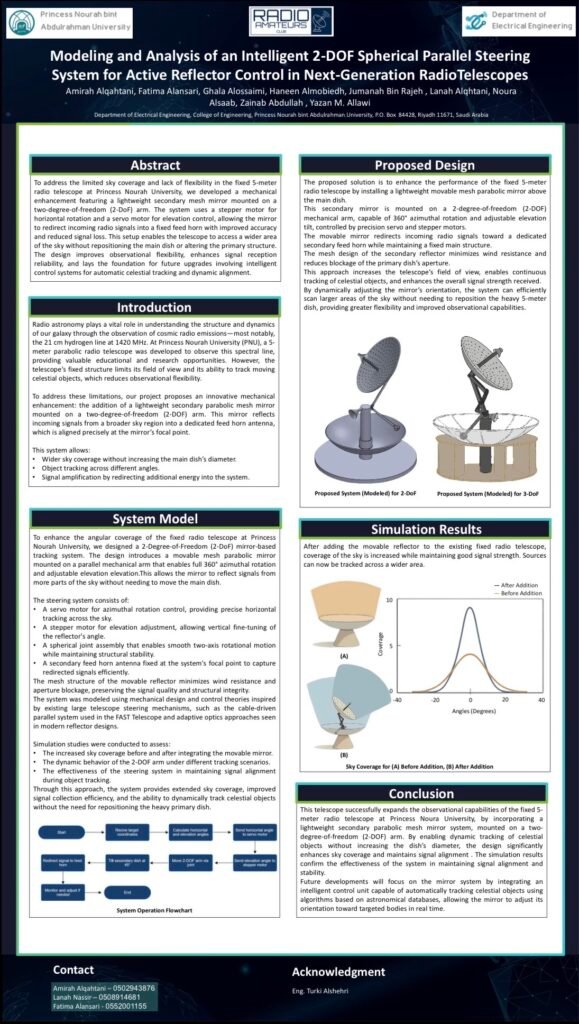
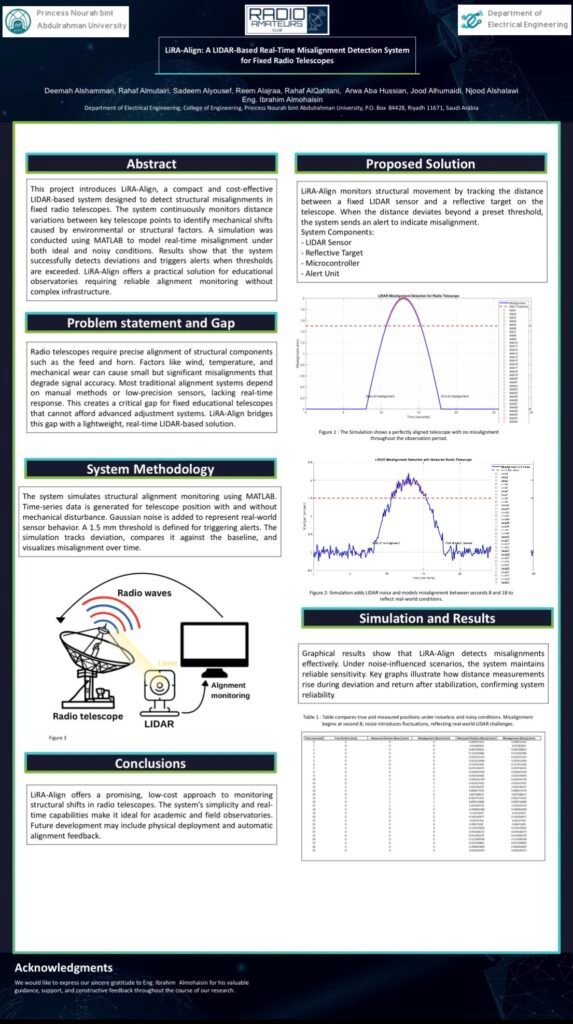
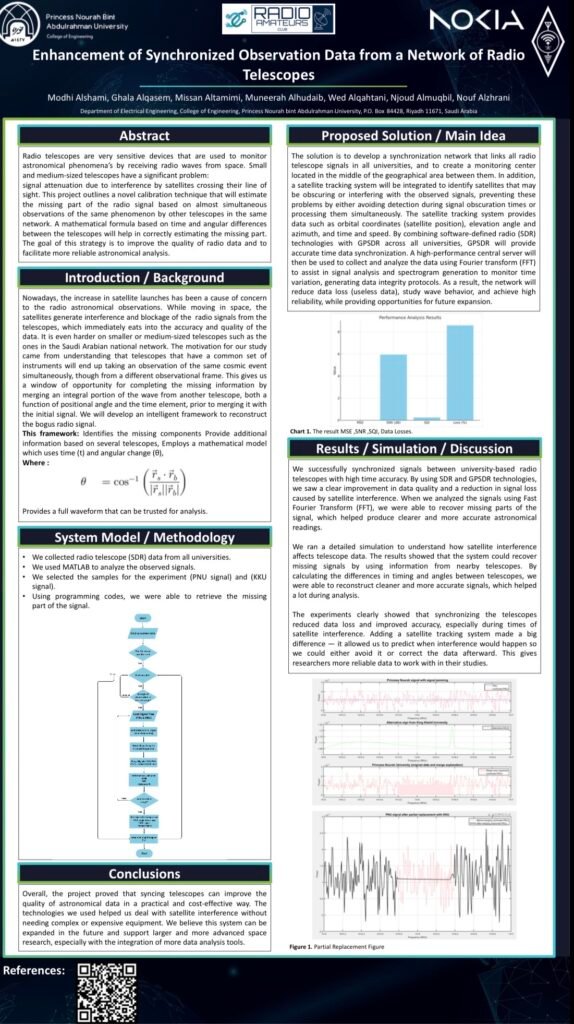
The idea started from observing that radio signals used in Radio Astronomy are affected as they pass through the Ionosphere, reducing observation quality and accuracy. Real data from the PNU Radio Telescope was therefore used to study and mitigate these effects.
02
The Idea
What Does the Project Offer?
The project provides a method for analyzing and improving radio signals using RFI Filtering and TEC-based Ionospheric Correction, aiming to reduce Ionospheric disturbances and improve SNR and observation quality.
03
The Experience
From Concept to Prototype
Project Team
Munirah Alduhayan
Lana Albraithen
Leen Alrazini
Retaj Alshahrani
Reema Almutlag
Latifah Bin Marhum
Layal Aldharman
Amirah Aldosariy
Project Supervisor
prof.Abdulrahman Malawi
Project Photo Gallery
A visual tour documenting the manufacturing stages, laboratory testing, and live tracking experiments in the field.
Other Projects in This Edition
Explore the projects and experiments that shape the Electrospace experience.