Quantum Ghost Imaging for High Resolution Signal Reception In Next Generation Radio Telescopes
Develop your technical skills
Discover Electrospace
Share your idea
Develop your project
Explore the world of wireless communications
Be part of the tech community
Project Idea
From an Idea to a Communication Experience
Traditional radio telescope techniques often struggle to obtain clear images of
faint celestial objects due to limitations in resolution and sensitivity, hindering
our understanding of the universe. This project explores the application of
quantum ghost imaging to enhance both resolution and sensitivity in signal
reception. Our objective is to develop a novel imaging technique that is capable
of providing high-resolution signals, even in low-light conditions. We found that
quantum ghost imaging significantly improves the clarity of astronomical
images compared to conventional methods, enabling the detection of faint
signals with up to a 50% enhancement in resolution and reduced noise levels.
These findings suggest that incorporating quantum ghost imaging into next-
generation radio telescopes will allow astronomers to capture previously
overlooked details of well-studied celestial objects and phenomena.
01
The Beginning
How Did the Idea Begin?
The idea started from a limitation in conventional Radio Telescopes: difficulty detecting faint celestial objects due to limited Resolution and Sensitivity. We proposed using Quantum Ghost Imaging to improve signal and image quality.
02
The Idea
What Does the Project Offer?
The project provides an imaging technique based on Quantum Ghost Imaging to improve Resolution and Sensitivity, reduce Noise, and detect faint astronomical signals more clearly.
03
The Experience
From Concept to Prototype
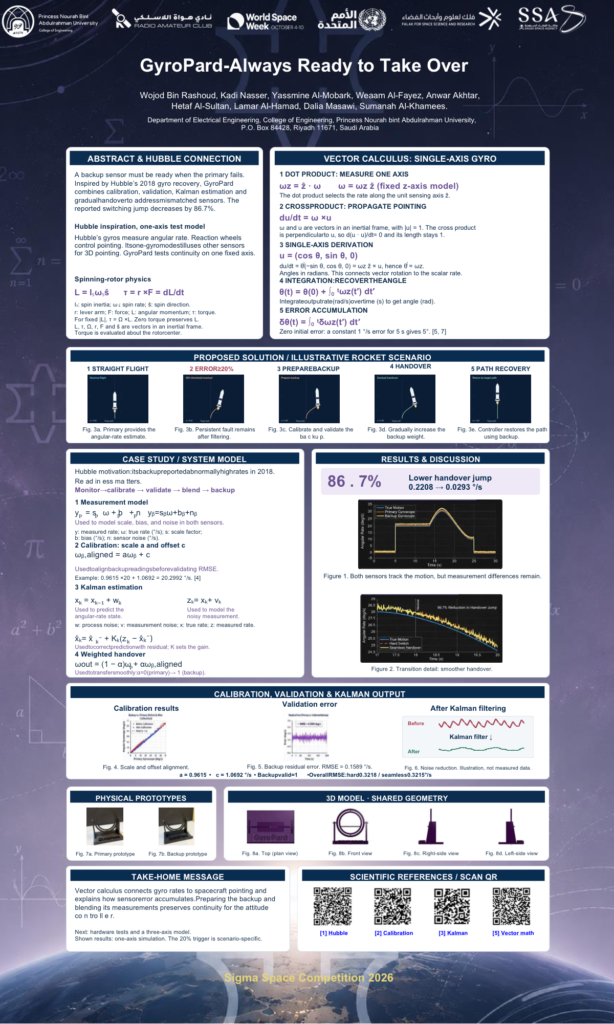
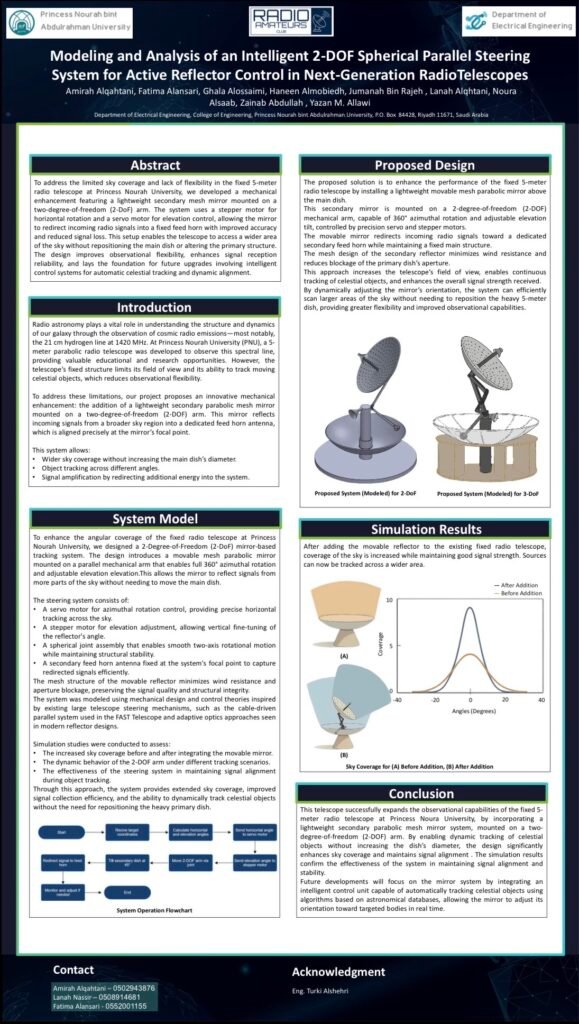
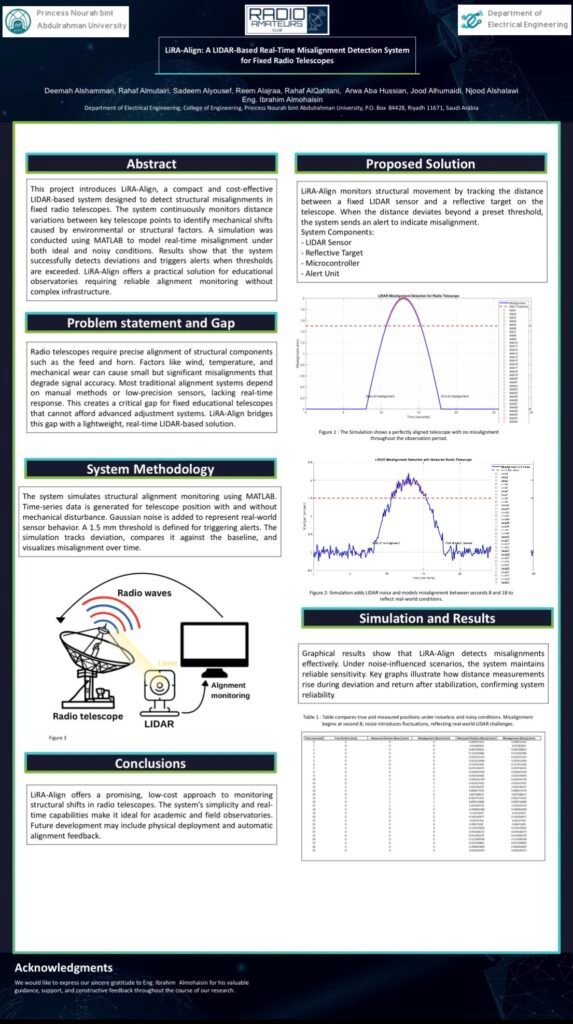
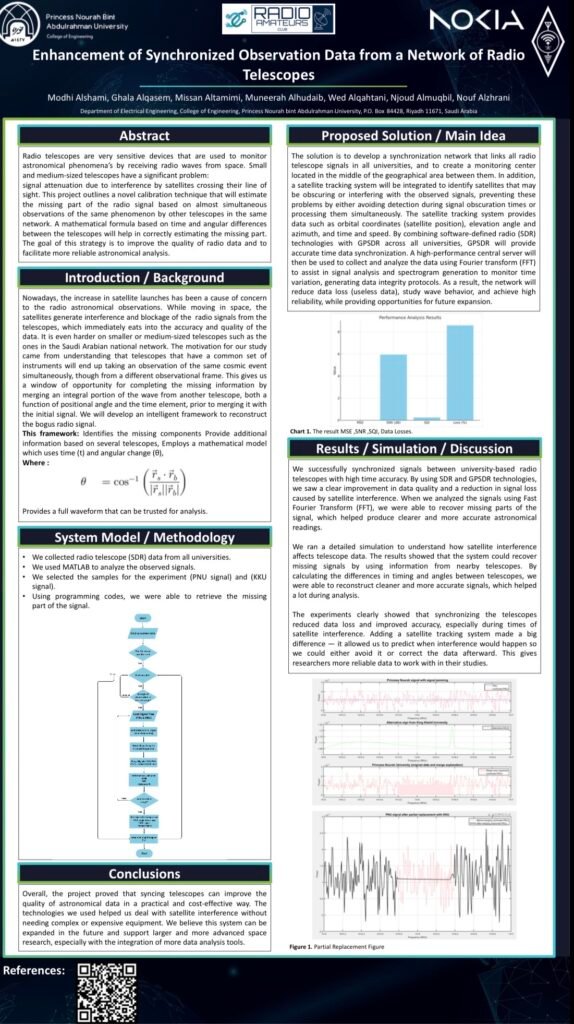
We first identified the limitations of conventional Radio Telescopes, then proposed Quantum Ghost Imaging as a solution. We developed a prototype to test and compare the technique with conventional methods, showing improved Resolution and reduced Noise.
Project Team
Nourah Alotaibi
Khloud Allahem
Reem Almutairi
Jood Abu Heeb
Haneen Aloraidi
Rawan Hazazi
Danah Alosaimi
Reem Alamri
Ghaday Alshehri
Project Supervisor
Dr. Yazan Allawi
Project Photo Gallery
A visual tour documenting the manufacturing stages, laboratory testing, and live tracking experiments in the field.
Other Projects in This Edition
Explore the projects and experiments that shape the Electrospace experience.