Smart Radio Telescope Enhancer Using AI-Driven Signal Filtering
Develop your technical skills
Discover Electrospace
Share your idea
Develop your project
Explore the world of wireless communications
Be part of the tech community
Project Idea
From an Idea to a Communication Experience
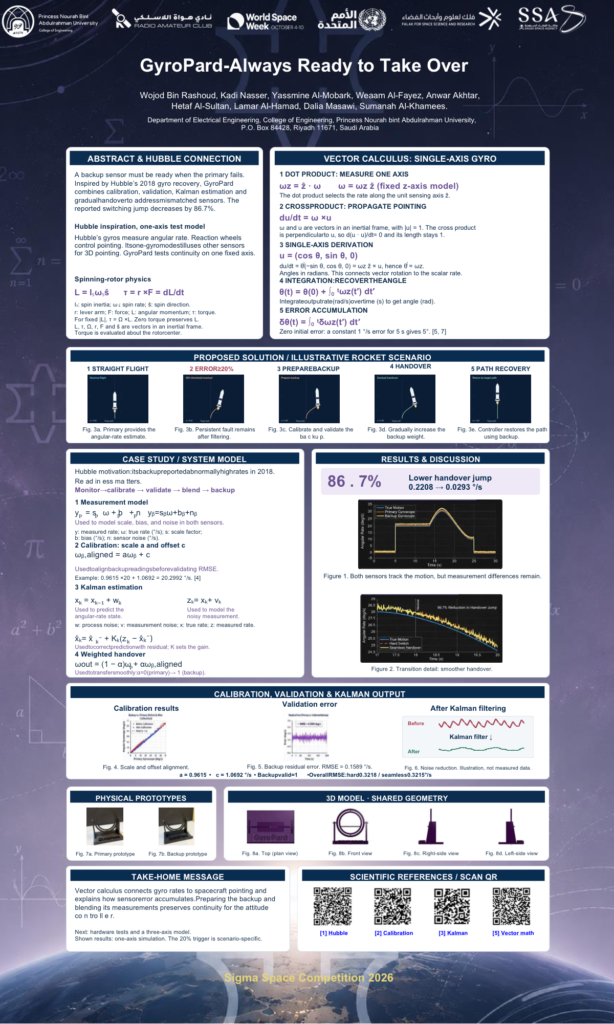
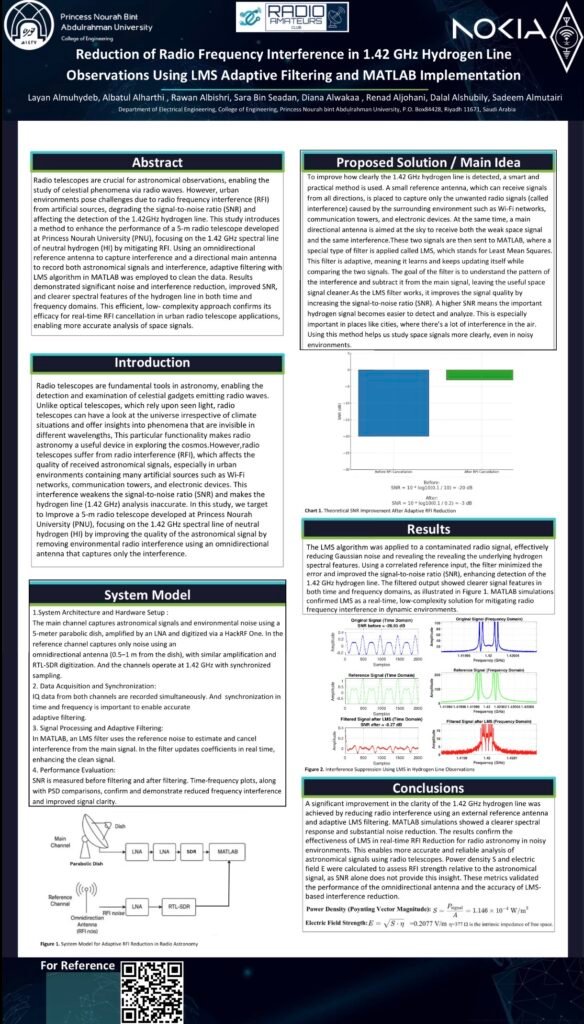
This project investigates the creation of an intelligent enhancementmodule aimed at enhancing the quality of signals received by radio
telescopes through AI-powered noise filtering. Constructed using a
filter out noise and uncover faint celestial signals. To assess thRaspberry Pi, the system analyzes raw astronomical data instantly,
utilizing machine learning particularly neural networks and SVM to
e
system, we utilized simulated radio signals containing Gaussian noise.
ese results indicate that a budget-friendly, compact platform cThe findings indicated that neural networks outperformed SVM in
improving signal clarity, realizing an average enhancement of 35% in
signal to noise ratio, and did so with low latency on a Raspberry Pi 4.
T
han
significantly improve the performance of radio telescopes. This study
lays a hopeful foundation for upcoming experimental trials and real
world applications in actual observational settings.
01
The Beginning
How Did the Idea Begin?
The idea started from the need to improve astronomical signal quality and remove Noise using AI instead of relying only on traditional methods.
02
The Idea
What Does the Project Offer?
The project provides an AI-Powered Noise Filtering Module running on a Raspberry Pi to improve signals, achieving a 35% improvement in SNR using Neural Networks.
03
The Experience
From Concept to Prototype
We started with the concept of using Machine Learning for signal processing. We then developed the system on a Raspberry Pi 4 and tested it with Simulated Radio Signals containing Gaussian Noise. Neural Networks and SVM were compared, with Neural Networks showing better performance.
Project Team
Haden Alkhodairi
Hesse Alsurayyi
Leen Alkelabi
Maisam Alyousef
Nada Alkhalaf
Refan Alrakaf
Raneem Alohali
Shouq Alarwan
Project Supervisor
Project Photo Gallery
A visual tour documenting the manufacturing stages, laboratory testing, and live tracking experiments in the field.
Other Projects in This Edition
Explore the projects and experiments that shape the Electrospace experience.